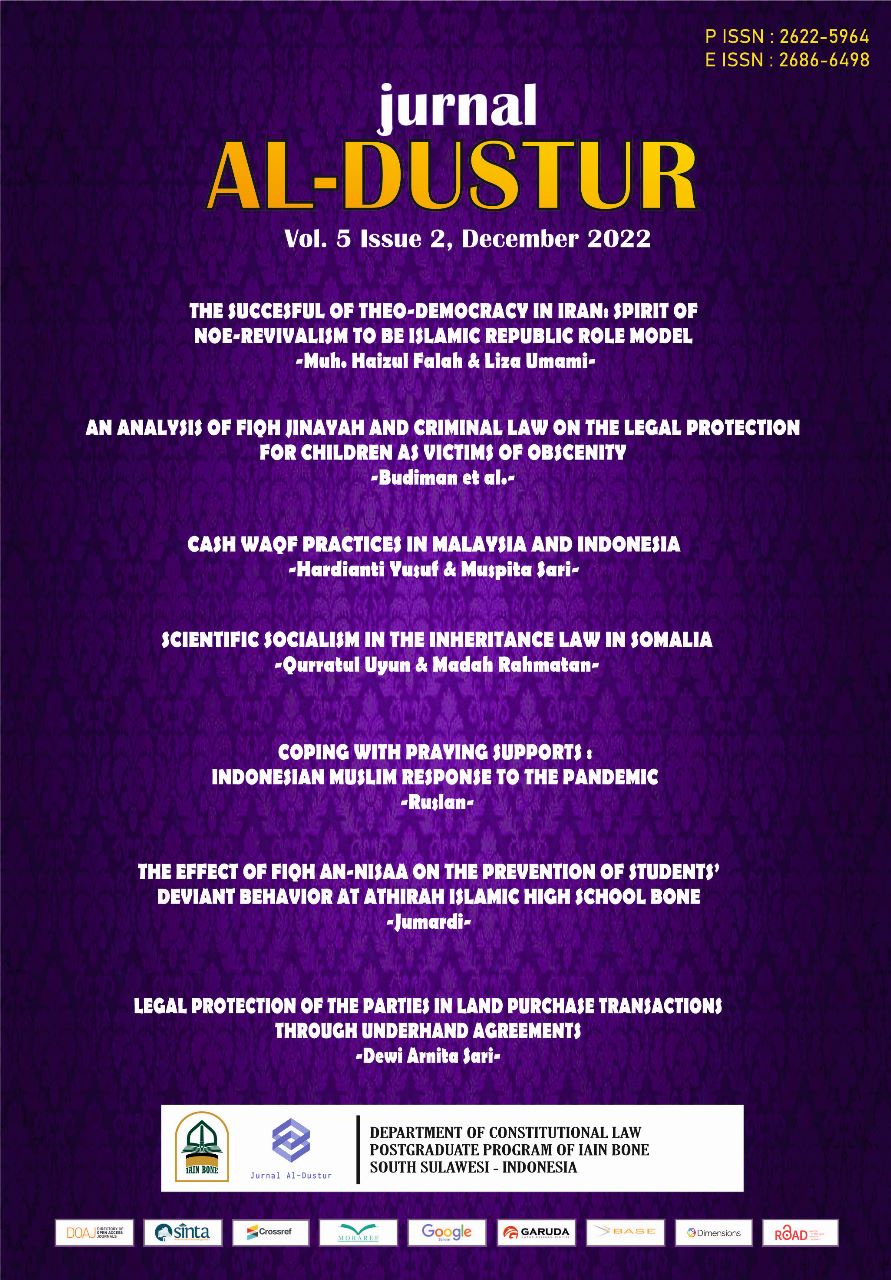
THE EFFECT OF FIQH AN-NISAA ON THE PREVENTION OF STUDENTS’ DEVIANT BEHAVIOR AT ATHIRAH ISLAMIC HIGH SCHOOL BONE
DOI:
https://doi.org/10.30863/aldustur.v5i2.3139Keywords:
Fiqh An-Nisaa, Behaviour, StudentAbstract
Fiqh An-nisaa has an influence in increasing the religious value of students who are just with the goals of the national education system and the goals of Islamic education. Which in substance is the ability to shape students into better individuals and avoid acts that are prohibited by religion (deviant). Therefore, there is a significant influence of the fiqh an-nisaa’s learning process on the prevention of deviant behavior of students at Athirah Islamic High School Bone which shows a probability value of 0.005 which is smaller than = 0.05 which can be accepted as an influential one. This means learning Fiqh An-Nisaa able to increase religious values and be able to minimize the occurrence of deviant behavior.
References
Ichsan Anshory dan Ima Wahyu Putri Utami, Pengantar Pendidikan (1st Print; Malang: UMM Press, 2018)
Achmadi, Ideologi Pendidikan Islam (1st Print; Yogyakarta: Pustaka Belajar, 2009)
Muhammad Yaumi, Pendidikan Karakter (Landasan, Pila dan Implementasi) (2nd Print; Jakarta: Prenada Media, 2016)
Haidar Putra Daulay, Pembedayaan Pendidikan Agama Islam di Sekolah (1st Print; Jakarta: Kencana, 2016)
Syamril dan Syamsul Bahri, Pendidikan Karakter ala Sekolah Islam Athirah Bone (Bone: Yayasan Kalla Sekolah Islam Athirah Bone, 2020)
Mukhlis Mukhtar, “Fiqh Perempuan: Kekinian dan Keindonesiaanâ€, Ash-Shahabah Jurnal Pendidikan dan Studi Islam, Vol. 5 No. 1, 2019.
Masri Singarimbun, Sopian Efendi. Metode Penelitian Survai (1st Print; Jakarta: LP3ES, 1989)
Sugiyono, Metode Penelitian Pendidikan (Pendekatan Kuantitatif, Kuatitatif, dan R&D) (14th Print; Bandung: Alfabeta, 2012).
Husein Umar, Metode Riset Perilaku Konsumen Jasa (Jakarta: Ghalia Indonesia, 2004).
Downloads
Published
Issue
Section
License
- Authors retain copyright and grant the journal right of first publication with the work simultaneously licensed under a Creative Commons Attribution-ShareAlike License (CC BY-SA 4.0) that allows others to share the work with an acknowledgement of the work's authorship and initial publication in this journal.
- Authors are able to enter into separate, additional contractual arrangements for the non-exclusive distribution of the journal's published version of the work (e.g., post it to an institutional repository or publish it in a book), with an acknowledgement of its initial publication in this journal.
- Authors are permitted and encouraged to post their work online (e.g., in institutional repositories or on their website) prior to and during the submission process, as it can lead to productive exchanges, as well as earlier and greater citation of published work.