
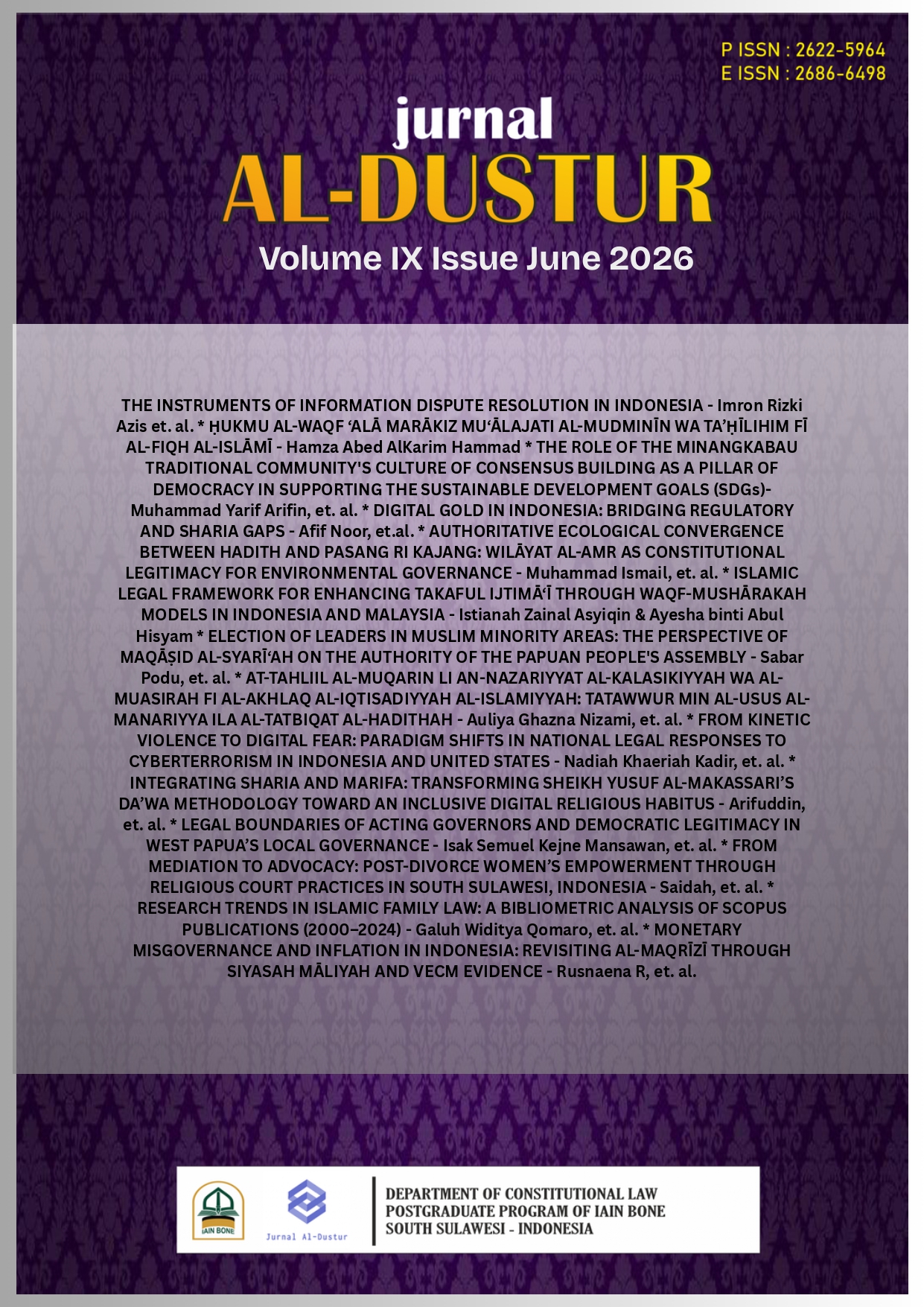
AT-TAHLIIL AL-MUQARIN LI AN-NAZARIYYAT AL-KALASIKIYYAH WA AL-MUASIRAH FI AL-AKHLAQ AL-IQTISADIYYAH AL-ISLAMIYYAH:
TATAWWUR MIN AL-USUS AL-MANARIYYA ILA AL-TATBIQAT AL-HADITHAH
DOI:
https://doi.org/10.30863/aldustur.v9i1.10827Keywords:
Islamic Economics, Classical Theory, Maqasid Sharia, Contemporary Theory, Comparative Analysisi., Economic EthicsAbstract
This study provides a comprehensive comparative analysis of classical and contemporary theories in Islamic economic ethics, examining the evolution from foundational principles established by early Muslim scholars to modern applications in the global economy. Through a systematic literature review of 47 scholarly works published between 2015-2025, this research identifies key distinctions in methodological approaches, practical applications, and theoretical frameworks between classical and contemporary Islamic economic thought. Classical theories, primarily developed by scholars such as Abu Yusuf, Al-Ghazali, and Ibn Khaldun, emphasized normative foundations rooted in Quranic injunctions and prophetic traditions, focusing on local community welfare and direct moral governance. Contemporary theories, advanced by scholars like M. Umer Chapra, Monzer Kahf, and Syed Nawab Haider Naqvi, integrate traditional Islamic principles with modern economic challenges, emphasizing institutional frameworks, global applicability, and empirical methodologies. The findings reveal significant complementarity between both approaches, with classical theories providing immutable ethical foundations while contemporary theories offer adaptive mechanisms for complex modern economies. The study concludes that successful implementation of Islamic economic ethics requires synthesis of classical normative principles with contemporary institutional innovations, particularly through maqashid al-shariah frameworks that bridge traditional wisdom with modern economic realities.
References
Al-Ghazali, Imam. Tahafut Al-Falasifah. Kairo: Darul Ma’arif, 1972. Reprint, Kairo: Darul Ma’arif, 1972.
Ali, Muhammad Aqib. “Growth and Development of Islamic Banking: A Global Review.” ResearchGate, ahead of print, August 9, 2025. https://doi.org/10.47067/ramss.v5i2.235.
Anisa, Lina Nur. “A Comparative Analysis Of Islamic Economic Thought: Abu Yusuf And M. Umer Chapra.” Journal of Economic and Islamic Research 3, no. 1 (December 2024): 342–65. https://doi.org/10.62730/journalofeconomicandislamicresearch.v3i1.127.
Arbi, Dion Saputra, Jonathan Farez Satyadharma, and Ihsan Hidayat. “The Impact Distribution of Zakat in Alleviating Poverty During COVID-19 Pandemic: Evidence From Indonesia.” Al-Iqtishad: Jurnal Ilmu Ekonomi Syariah 16, no. 1 (June 2024). https://doi.org/10.15408/aiq.v16i1.35678.
BAZNAS RI. “Zakat and Poverty Alleviation Report BAZNAS RI 2023.” Google Docs. Accessed December 1, 2025. https://drive.google.com/file/d/1hEOgHFIEDjJFlArs0zxLrLPYlBWTjR7b/view?usp=drive_link&usp=embed_facebook.
Bella, Alif Mujiyana Eka. “Development Of Monzer Kahf’s Islamic Consumption Theory And Ethics.” Islamic Economics and Business Review 3, no. 3 (December 2024). https://doi.org/10.59580/iesbir.v3i3.8868.
Biancone, Paolo Pietro, Buerhan Saiti, Denisa Petricean, and Federico Chmet. “The Bibliometric Analysis of Islamic Banking and Finance.” Journal of Islamic Accounting and Business Research 11, no. 10 (October 2020): 2069–86. https://doi.org/10.1108/JIABR-08-2020-0235.
Chapra, M. Umer [Muhammad Umer]. “The Future of Islamic Economics : An Islamic Perspective.” Universitas Indonesia Library, Islamic Foundation, 2000. https://lib.ui.ac.id.
Chapra, Mohammad Umar. “The Islamic Vision of Development in the Light of the Maqasid Al-Shari’ah (Research Paper).” Occasional Papers, Occasional Papers, 2008, 235. https://ideas.repec.org//p/ris/irtiop/0235.html.
Djakfar, Muhammad. “Contemporary Islamic Economic Thinking: A Sharia-Based Work Culture Reconstruction.” KARSA Journal of Social and Islamic Culture 24, no. 2 (December 2016): 269–81. https://doi.org/10.19105/karsa.v24i2.1127.
Faizah, Nur, and Slamet Haryono. “The Impact of the Distribution of Zakat Funds on Poverty Alleviation in Indonesia.” ZISWAF: JURNAL ZAKAT DAN WAKAF 12, no. 1 (June 2025): 82–93. https://doi.org/10.21043/ziswaf.v12i1.27335.
Furqani, Hafas. “Individual and Society in an Islamic Ethical Framework: Exploring Key Terminologies and the Micro-Foundations of Islamic Economics.” Humanomics 31, no. 1 (February 2015): 74–87. https://doi.org/10.1108/H-04-2014-0037.
Furqani, Hafas, Gunawan Adnan, and Ratna Mulyany. “Ethics in Islamic Economics: Microfoundations for an Ethical Endogeneity.” International Journal of Ethics and Systems 36, no. 3 (August 2020): 449–63. World. https://doi.org/10.1108/IJOES-03-2020-0032.
Hadiat, Hadiat, Yadi Janwari, Muhammad Hasanuddin, and Mohamad Anton Athoillah. “Islamic Economic Solutions to Poverty and Inequality in Indonesia: Bridging Faith, Practice, Inflation, and the Balance of the Financial System.” Asian Journal of Islamic Studies and Da’wah 3, no. 1 (January 2025): 68–90. https://doi.org/10.58578/ajisd.v3i1.4541.
Harahap, Soritua Ahmad Ramdani, Hartomi Maulana, Hayatul Maemunah, and Muhammad Rizky Rahmadani. “The Maqasid Al-Shariah Model and Its Application in Islamic Banking: An Analysis From Scholars And Academics Perspective.” El-Kahfi | Journal of Islamic Economics 5, no. 01 (March 2024): 91–102. https://doi.org/10.58958/elkahfi.v5i01.229.
ICD – LSEG Islamic Finance Development Report 2025. n.d.
IFSB. “Islamic Financial Services Industry Stability Report 2023.” Islamic Financial Services Board, 2023. https://www.ifsb.org/publication-document/islamic-financial-services-industry-stability-report-2023/.
Iqbal, Muhammad. “Critical Review of Islamic Economic Thoughts Based on the Perspective of Three Schools (Mazhab): Iqtishaduna, Mainstream, and Alternative-Critical.” KnE Social Sciences, May 17, 2024, 106–18. https://doi.org/10.18502/kss.v9i16.16238.
Kahf, Monzer. “Islamic Economics: Notes on Definition and Methodology.” ResearchGate, 2020. https://www.researchgate.net/publication/242301941_Islamic_economics_Notes_on_definition_and_methodology.
Kaira, Lamin, Gehad Mohammed Sultan Saif, Nurlita Arum, Lulu Hardina, Arif Nur Rahman, and Aditya Danang Saputra. “Uncovering Maqoshid Sharia: Safeguarding Ethics in Islamic Economics.” Journal International Economic Sharia 1, no. 1 (June 2024): 17–24. https://doi.org/10.5281/zenodo.11525329.
Muhardi, Sulaiman, and Mustamin B. 2025. “Shariah-Based Employee Retention in the Gig Economy: The Role of Hybrid Work Culture and Digital Platforms”. BANCO: Jurnal Manajemen Dan Perbankan Syariah 7 (2):132-48. https://doi.org/10.35905/banco.v7i2.14059.
Mansyur, Abdussalam, Nur Asnawi, Umrotul Khasanah, and Jakfar Shodiq. “The Evolving Relationship between Islamic Economic Theory and Fiqh Al-Muamalat in Modern Financial Systems: A Comprehensive Analysis.” An-Natiq Jurnal Kajian Islam Interdisipliner 5, no. 1 (April 2025): 1–22.
Mukhtar, Muhammad Naufal, and Khusnudin Khusnudin. “History of Markets, Hisbah and Its Implementation In The Era ff The Prophet SAW Until Modern Times.” Profit : Jurnal Kajian Ekonomi Dan Perbankan Syariah 8, no. 2 (2024): 60–69. https://doi.org/10.33650/profit.v8i2.11840.
“Navigating Uncertainty: Global Islamic Finance Assets Expected to Exceed 6.7 Trillion by 2027.” February 26, 2024. https://www.lseg.com/en/insights/data-analytics/navigating-uncertainty-global-islamic-finance-assets-expected-to-exceed-67-trillion-by-2027.
Rohim, Ade Nur, and Fitri Yetty. “Contribution of Islamic Economy in Achieving Sustainable Development Goals (SDGs).” Review of Islamic Social Finance and Entrepreneurship, March 10, 2025, 56–69. https://doi.org/10.20885/RISFE.vol4.iss1.art5.
“Standard Chartered: ‘Global Islamic Finance Assets to Surpass USD 7.5 Trillion by 2028.’” Standard Chartered, n.d. Accessed December 1, 2025. https://www.sc.com/en/press-release/standard-chartered-global-islamic-finance-assets-to-surpass-usd-7-5-trillion-by-2028/.
Tuli, Ela, and Shikhar Dua. “Harmonizing Islamic Finance Principles with Microeconomics and Macroeconomics Theories: A Sacred Perspective.” Review of Islamic Economics and Finance 8, no. 1 (May 2025): 19–40. https://doi.org/10.17509/rief.v8i1.79443.
Widjaja, Gunawan. 2025. “Dispute Resolution in Islamic Economic Transactions: The Role and Function of Sharia Arbitration”. Journal of Islamic Economic Laws 8 (01):60-78. https://doi.org/10.23917/jisel.v8i01.6340.
Wilson, Rodney. “Innovation in the Structuring of Islamic Sukuk Securities.” Humanomics 24, no. 3 (August 2008): 170–81. https://doi.org/10.1108/08288660810899340.
Zaman, Asad. “Islam’s Gift: An Economy of Spiritual Development.” SSRN Scholarly Paper No. 3321866. Rochester, NY: Social Science Research Network, January 13, 2019. https://papers.ssrn.com/abstract=3321866.
Zuwardi, Zuwardi, Loso Judijanto, Al-Amin Al-Amin, Syaifullah Ms, Irnayenti Irnayenti, and Saputra Doni. “The Interconnection of Islamic Ethics and Economic Practice: A Bibliometric Analysis.” International Journal of Social Science and Business 9, no. 1 (February 2025): 72–86. https://doi.org/10.23887/ijssb.v9i1.94637.
Downloads
Published
Issue
Section
License
Copyright (c) 2026 Auliya Ghazna Nizami, Abdul Mustaqim, Moh. Mufid

This work is licensed under a Creative Commons Attribution-ShareAlike 4.0 International License.
- Authors retain copyright and grant the journal right of first publication with the work simultaneously licensed under a Creative Commons Attribution-ShareAlike License (CC BY-SA 4.0) that allows others to share the work with an acknowledgement of the work's authorship and initial publication in this journal.
- Authors are able to enter into separate, additional contractual arrangements for the non-exclusive distribution of the journal's published version of the work (e.g., post it to an institutional repository or publish it in a book), with an acknowledgement of its initial publication in this journal.
- Authors are permitted and encouraged to post their work online (e.g., in institutional repositories or on their website) prior to and during the submission process, as it can lead to productive exchanges, as well as earlier and greater citation of published work.



