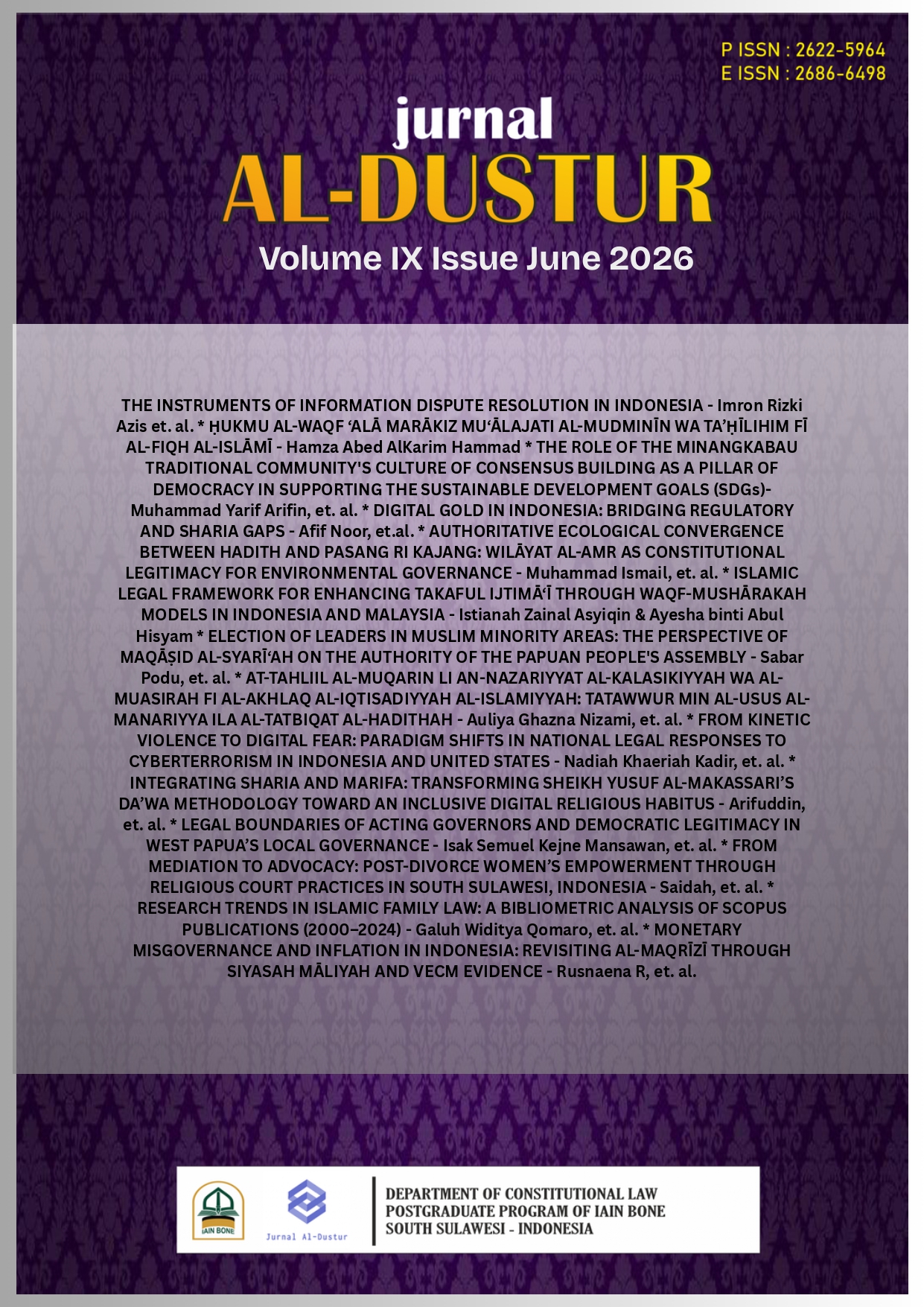
THE INSTRUMENTS OF INFORMATION DISPUTE RESOLUTION IN INDONESIA
DOI:
https://doi.org/10.30863/aldustur.v9i1.10449Keywords:
Information Comission, Public Information Disclosure, Information Dispute, Right to Information, Dispute ResolutionAbstract
The term 'public information disclosure' began to receive attention in 2008, following the enactment of the Public Information Disclosure Law, which mandated the establishment of the Information Commission. This institution is expected to guarantee citizens’ rights to access information, including the resolution of information-related disputes. This study investigated the implementation and effectiveness of the existing regulations, with particular emphasis on the role and function of the Information Commission in resolving public information disputes in Indonesia. In addition, the research explored the distribution of judicial authority between the Information Commission and the judiciary. The findings revealed that the existence of the Information Commission has not yet fully ensured effective public information disclosure. Many disputes resolved by the Commission are further escalated to the courts, including to the Supreme Court at the cassation level. This process often causes delays for information requesters and is exacerbated by the non-compliance of certain public bodies with the Commission’s decisions. The study also examined the institutional status of both the Central and Regional Information Commissions. The establishment of regional commissions was found to lack independence, as their formation and status are not structurally integrated with the Central Commission. This research is significant as it centers on the resolution of information disputes and provides a comparative analysis of public information disclosure practices in Indonesia and in other countries such as Sweden, Canada, and Japan.
References
Agustina, Dini, Jamalullail Jamalullail, and Arief Subhan. “Conflict Resolution, Prevention and Handling Public Information Disputes.” Jurnal Indonesia Sosial Sains 5, no. 1 (2024): 103–13. https://doi.org/10.59141/jiss.v5i1.984.
Anggia, Putri, Ani Yunita, and Fadia Fitriyanti. “Legal Justice: The Abolition of the Principle of Bank Secrecy for Tax Interests in Indonesia.” Jambura Law Review 5, no. 2 (2023): 314–31. https://doi.org/10.33756/jlr.v5i2.18793.
Antara. “Komisi Informasi Pusat Kunjungi IPC Di Kanada Pelajari Model Integrasi,” 2024. https://www.antaranews.com/berita/4377638/komisi-informasi-pusat-kunjungi-ipc-di-kanada-pelajari-model-integrasi.
Banisar, David. “Freedom of Information around the World 2006: A Global Survey of Access to Government Information Laws.” Privacy International. Vol. 25, 2006.
Christopher, Hood and David Heald. Transparency: The Key to Better Governance? oxford: Oxford University Press, 2006.
Dipopramono, Abdulhamid. Keterbukaan Dan Sengketa Informasi Publik. Edited by Luqman Hakim Arifin and Tria Nurchayati. 1st ed. Jakarta Selatan: Renebook, 2017.
Donnely, Jack. Universal Human Rights in Theory and Practice. ithaca and London: Cornell University Press, 2003.
Febriananingsih, Nunuk. “Keterbukaan Informasi Publik Dalam Pemerintahan Terbuka Menuju Tata Pemerintahan Yang Baik.” Jurnal Rechts Vinding: Media Pembinaan Hukum Nasional 1, no. 1 (2012): hlm. 152. https://doi.org/10.33331/rechtsvinding.v1i1.110.
Fenster, Mark. “Transparency in Search of a Theory.” European Journal of Social Theory 18, no. 2 (2015): 150–67. https://doi.org/10.1177/1368431014555257.
Gavuzzi, Oliver. “Public Access to Documents in Sweden and the EU An Examination and Comparison of Applicable Law.” UMEA University, 2015.
Hins, Wouter, and Dirk Voorhoof. “Access to State-Held Information as a Fundamental Right under the European Convention on Human Rights.” European Constitutional Law Review 3, no. 1 (2007): 114–26. https://doi.org/10.1017/S1574019607001149.
Indonesia, Republik. Undang-Undang Nomor 14 Tahun 2008 Tentang Keterbukaan Informasi Publik (2008).
Jannah, Lina Miftahul, Muhammad Yasin Sipahutar, and Desy Hariyati. “Public Information Disclosure: Mapping the Understanding of Multiple Actors in Corruption-Prone Indonesian Provinces Introduction The Implementation of Regional Autonomy That Began since The.” Policy and Governace REview 4, no. 3 (2020): 167–81. https://doi.org/10.30589/pgr.
Latif, Birkah, S M Noor, Juajir Sumardi, and Irwansyah. “Human Rights Protection in Trade : A Challenge Perlindungan Hak Asasi Manusia Dalam Perdagangan : Sebuah Tantangan A . Introduction States Always Seek and Optimize Sources of Revenue for the Welfare of Its People . To Be Wealthy , a State Also Always Conn.” Padjajaran Journal of Law 5, no. 2 (2018): 368–86.
Lei, Zhang, Arthur P.J. Mol, and Guizhen He. “Transparency and Information Disclosure in China’s Environmental Governance.” Current Opinion in Environmental Sustainability 18, no. 2 (2016): 17–24. https://doi.org/10.1016/j.cosust.2015.03.009.
Lubis, Muharman, Tien Fabrianti Kusumasari, and Lukmanul Hakim. “The Indonesia Public Information Disclosure Act (UU-KIP): Its Challenges and Responses.” International Journal of Electrical and Computer Engineering 8, no. 1 (2018): 94–103. https://doi.org/10.11591/ijece.v8i1.pp94-103.
Muhaimin. “Implementasi Kebijakan Keterbukaan Informasi Publik.” Jurnal Ilmu Administrasi Negara ASIAN (Asosiasi Ilmuwan Administrasi Negara) 11, no. 2 (2023): 31–45. https://doi.org/10.47828/jianaasian.v11i2.158.
Mustika, Cindyva Thalia, Suprapto, and Achmad Faishal. “Penerapan Asas Lex Superior Derogat Legi Inferior Dalam Penyelesaian Sengketa Informasi Publik.” Banua Law Riview 3, no. 1 (2021): 87–97. http://balrev.ulm.ac.id/index.php/balrev.
Mustofa, Syahrul. Hukum Keterbukaan Informasi Publik Di Indonesia. Edited by Guepedia. Mataram: Guepedia, 2020.
Muttaqien, Zainal, Dicky Risman, and Susi Dwi Harijanti. “Implementasi Pelayanan Publik Di Bidang Pendidikan Tinggi Sebagai Upaya Pemenuhan Hak Asasi Manusia Prosedural Di Universitas Padjajaran.” Bandung, 2010.
Naelufar, Rizqan. “Perluasan Kompetensi Ptun Dalam Mengadili Sengketa Informasi Publik.” UNNES LAW JOURNAL 2, no. 1 (2013): hlm. 65.
Prasetyo, Tony. “Penyelesaian Sengketa Keterbukaan Informasi Publik Di Pengadilan Tata Usaha Negara Semarang.” Jurnal Spektrum Hukum 13, no. 2 (2016): 181–98.
Radetzky, Michael Alexander. "The Impact of Artificial Technology on Authors of a Cinematographic Creation." Hasanuddin Law Review 10, no. 1 (2024): 21-42. https://doi.org/10.20956/halrev.v10i1.4780
Roberts, Alasdair. “Limited Access: Assessing The Health of Canada’s Freedom of Information Laws.” Belfast, 1998.
Sholahuddin, Al-Fatih, and Zaka Firma Aditya. “The Beginning of the Human Rights 5th Generation: A Lesson from Covid-19 Outbreak in Indonesia.” Jambe Law Journal 7, no. 1 (2024): 59–89. https://doi.org/10.22437/home.v7i1.339.
Sholehudin, Mifahus, Moh Fadli, Rachmi Sulistyarini, and Djumikasih. “Cancellation of Marriage Due to Apostasy in Islamic Law and Human Rights: A Comparative Analysis of Indonesia and Malaysia.” De Jure: Jurnal Hukum Dan Syar’iah 17, no. 1 (2025): 33–51. https://doi.org/10.18860/j-fsh.v17i1.31465.
Smith, Rhona K.M., Njäl Høstmælingen, Christian Ranheim, Satya Arinanto, Fajrul Falaakh, Enny Soeprapto, Ifdhal Kasim, et al. Hukum Hak Asasi Manusia. Yogyakarta: PUSHAM UII, 2008.
Tuan, Tran Anh, and Tran Kien. "The Artist’s Resale Right: Global Perspectives and Vietnam’s Path to Protection under the EVFTA." Hasanuddin Law Review (2025): 183-208. https://doi.org/10.20956/halrev.v11i2.6558
Downloads
Published
Issue
Section
License
Copyright (c) 2026 Imron Rizki Azis, Aidir Amin Daud, Ahmad Muhtaram, Pipit Somefotorono Majid

This work is licensed under a Creative Commons Attribution-ShareAlike 4.0 International License.
- Authors retain copyright and grant the journal right of first publication with the work simultaneously licensed under a Creative Commons Attribution-ShareAlike License (CC BY-SA 4.0) that allows others to share the work with an acknowledgement of the work's authorship and initial publication in this journal.
- Authors are able to enter into separate, additional contractual arrangements for the non-exclusive distribution of the journal's published version of the work (e.g., post it to an institutional repository or publish it in a book), with an acknowledgement of its initial publication in this journal.
- Authors are permitted and encouraged to post their work online (e.g., in institutional repositories or on their website) prior to and during the submission process, as it can lead to productive exchanges, as well as earlier and greater citation of published work.