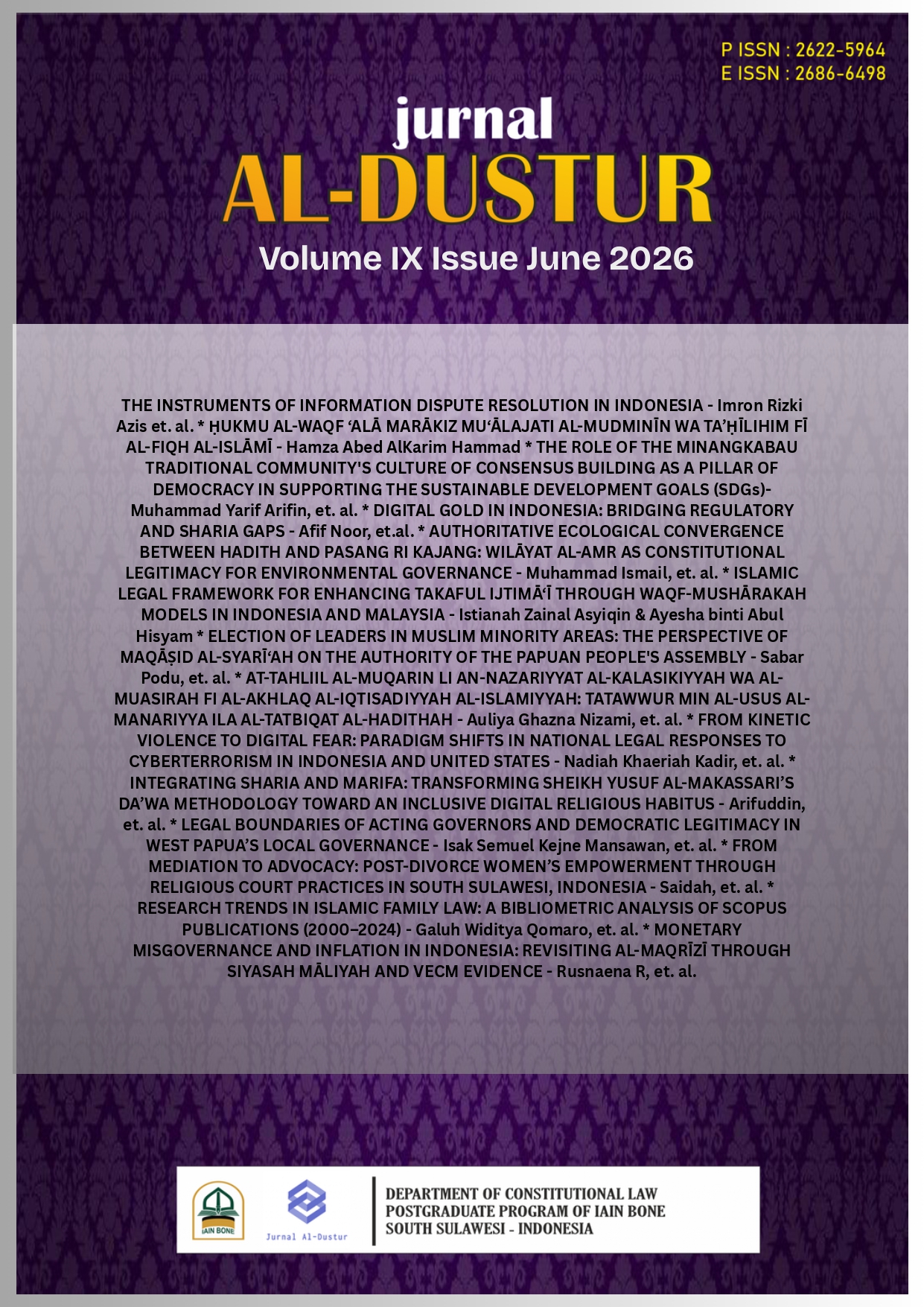
LEGAL BOUNDARIES OF ACTING GOVERNORS AND DEMOCRATIC LEGITIMACY IN WEST PAPUA’S LOCAL GOVERNANCE
DOI:
https://doi.org/10.30863/aldustur.v9i1.10642Keywords:
Acting Governor, Regional Autonomy, Democratic Legitimacy, Governance, West PapuaAbstract
Acting Governors (Pj Governors) in Indonesia, including in West Papua, are temporary officials appointed to fill vacancies in regional head positions based on statutory provisions. Their existence is crucial to ensure the continuity of local governance. However, in practice, the role of Acting Governors often raises issues concerning political legitimacy, governance effectiveness, and the legal implications of their authority. This study analyzes the legal basis and scope of authority of the Acting Governor of West Papua, examines its implementation in regional governance practice, and formulates recommendations for improving effective, transparent, and accountable governance. This research employs empirical legal research with a juridical-normative and conceptual approach, supported by qualitative descriptive analysis through legislation review, interviews, and documentation. The findings show that the authority of Acting Governors is normatively well-regulated, yet its implementation still faces challenges such as limited technical regulations, weak institutional capacity, and local political pressures influencing decision-making processes. Therefore, strengthening regulatory frameworks, enhancing transparency and accountability, and optimizing coordination between central and regional governments are necessary. These efforts are expected to ensure more stable, effective, and balanced governance between national and regional interests, while also supporting sustainable development and improving public service quality in West Papua in particular effectively.
References
Administrasi Pemerintahan et al. (2014). Law No. 30 of 2014 on Government Administration.
Ahmad, Saiful; Simin, Fahmy Adriawan; Umakaapa, Muh. Haikal. (2023). Conflict of Authority in the Appointment of Acting Regional Heads: The Case of the Acting Regent of Pulau Morotai, North Maluku in 2022. Comserva: Journal of Research and Community Service, 2(09), 1729–1742.
Ariyanto, Bambang. (2020). Management of Central and Regional Government Relations in Handling the COVID-19 Pandemic. Suloh: Journal of the Faculty of Law, Universitas Malikussaleh, 8(2), 37–57.
Ashari et al. (2024). Implications of the Authority of Acting Regional Heads in Civil Service Governance Following the Minister of Home Affairs Circular Letter No. 821/5492/SJ. Innovative: Journal of Social Science Research, 4(1), 11635–11644.
BAPPENAS RI. (2005). Government Regulation (PP) No. 6 of 2005 on the Election, Ratification of Appointment, and Dismissal of Regional Heads and Deputy Regional Heads.
Bauw, Lily. (2018). Special Autonomy of Papua: A Review from the Perspective of the Unitary State of the Republic of Indonesia. Papua Law Journal, 1(1), 1–26. https://doi.org/10.31957/plj.v2i2.578
Herlina, Merli. (2021). Sources of Authority of Government Bodies or Administrative Officials. Universitas Ekasakti Padang.
Huraerah, Abu. (2022). Social Protection Policy: Theory and Application of Dynamic Governance. Nuansa Cendekia.
Irfani, Hafid; Alamanda, Asri Elies. (2024). Principles of Transparency and Accountability in the Appointment of Acting Regional Heads. Justitiable: Law Journal, 6(2), 165–181.
Jagat Papua. "Paulus Waterpauw Lantik Empat Lembaga Keagamaan Papua Barat." September 21, 2022. https://www.jagatpapua.com/paulus-waterpauw-lantik-empat-lembaga-keagamaan-papua-barat/.
Khairiah, Umi; Sipahutar, Ervina Sari; Sipahutar, Anjani. (2024). Synergy of Authority between the National Police and Regional Government in Maintaining Public Security and Order within Regional Autonomy. Jurnal Normatif, 4(1), 336–344.
Kusuma, Mochammad Tommy; Rohmah, Elva Imeldatur; Mubarok, Nafi. (2022). Filling the Vacancy of Regional Head Positions Ahead of the 2024 Simultaneous Elections. Sosio Yustisia: Journal of Law and Social Change, 2(2), 1–33.
Marzuki, Peter Mahmud. (2017). Legal Research: Revised Edition. Prenada Media. https://books.google.co.id/books?id=CKZADwAAQBAJ
Nashrullah, Jauhar; Lohalo, Georges Olemanu. (2022). The Establishment of a New Autonomous Region of Papua in State Administrative Law Perspective. Volksgeist: Jurnal Ilmu Hukum Dan Konstitusi, 5(2), 145–159. https://doi.org/10.24090/volksgeist.v5i2.6901
Nuryani, Ani. (2023). Addition of Authority for Civil Servant Transfers by Acting Regional Heads in Minister of Home Affairs Circular Letter No. 821/5492/SJ from the Perspective of Maslahah Mursalah. UIN Prof. KH Saifuddin Zuhri Purwokerto.
Patricia, Laurene. (2023). Democratic Crisis Due to the Appointment of Acting Governor of DKI Jakarta Without Public Votes. Journal of Tambusai Education, 7(1), 1465–1473.
Pramudana, Ibnu; Perdana, Surya. (2023). Analysis of the Authority of Acting Regional Heads According to Law Number 23 of 2014. EduYustisia, 2(1), 17–30.
President of the Republic of Indonesia. (2014). Law of the Republic of Indonesia Number 23 of 2014 on Regional Government.
Pringgodo, Heru Kunprasetyo. (2019). Juridical Analysis of the Appointment of Police Officials as Acting Governors from the Perspective of Positive Law and Fiqh Siyasah. UIN Fatmawati Sukarno Bengkulu.
Rahayu, Nunung Puji. (2023). Harmonization of Legal Regulations on the Term of Office of Regional Heads Elected in 2020. UPN Veteran East Java.
Rahmazani. (2023). The Problems of Appointment Acting Officer of Regional Head in the Transition Period Before the Election of 2024. Jurnal Konstitusi, 20(2), 196–215. https://doi.org/10.31078/jk2022
Ramdani, Dadan. (2022). Problems in the Appointment of Acting Regional Heads During the Transition Period of the National Simultaneous Regional Elections 2024.
Razak, Askari. (2023). Appointment of Governors by the President in the Draft Law on the Special Region of Jakarta: Controversy and Orientation. UNES Law Review, 6(2), 6242–6252.
Republik Indonesia. (2016). Law of the Republic of Indonesia Number 10 of 2016 concerning the Second Amendment to Law Number 1 of 2015.
Riniwati, Harsuko. (2016). Human Resource Management: Main Activities and Human Resource Development. Universitas Brawijaya Press.
Roring, Edward Benedictus et al. (2024). Comparison of Constitutional Systems in the United States and Indonesia: Implications for National Political Stability. Communitarian: Jurnal Prodi Ilmu Politik, 6(1).
Santika, Wa; Putra, L M Ricard Zeldi; Supriyanto, Hadi. (2023). Legal Review of the Limitations of Authority of Acting Regents Based on Law of the Republic of Indonesia Number 23 of 2014 on Regional Government. Sultra Law Review, 5(02), 6–11.
Sarajar, Juvisher Vigoh Rivaldo. (2020). Authority of Environmental Supervisory Officers under Law Number 32 of 2009 on Environmental Protection and Management. Lex Et Societatis, 8(4).
Sugiharta, Iqbal Rifanda; Fauziyah; Fitri, Icha Cahyaning. (2024). The Controversy of Filling the Vacancy of the Governor's Office in the Perspective of Democracy in Indonesia. Indonesian Journal of Law and Justice, 1(4), 8. https://doi.org/10.47134/ijlj.v1i4.2260
Tahir, Arifin MSi; Isa, Rusli MSi; Nani, Yacop Noho. (2024). Textbook of Selected Topics in Local Government Management. CV. Cahaya Arsh Publisher & Printing.
Triono, Suryo; Dewi, Septiana Novita. (2020). The Effect of Internal Control Systems on the Quality of Local Government Financial Reports. Journal of Accounting and Tax, 21(1), 213–220.
Usman, S. (2022). Polemics of the Appointment of Acting Regional Heads. Journal of Social Sciences and Humanities (JSSH), 2(1), 63–73. https://doi.org/10.52046/jssh.v2i2.1144
Downloads
Published
Issue
Section
License
Copyright (c) 2026 Isak Semuel Kejne Mansawan, Faisal Abdullah, Abdul Razak, Filep Wamafma, Elsye Yubilia Keysinaya

This work is licensed under a Creative Commons Attribution-ShareAlike 4.0 International License.
- Authors retain copyright and grant the journal right of first publication with the work simultaneously licensed under a Creative Commons Attribution-ShareAlike License (CC BY-SA 4.0) that allows others to share the work with an acknowledgement of the work's authorship and initial publication in this journal.
- Authors are able to enter into separate, additional contractual arrangements for the non-exclusive distribution of the journal's published version of the work (e.g., post it to an institutional repository or publish it in a book), with an acknowledgement of its initial publication in this journal.
- Authors are permitted and encouraged to post their work online (e.g., in institutional repositories or on their website) prior to and during the submission process, as it can lead to productive exchanges, as well as earlier and greater citation of published work.